
Why Windows Matter More Than Extra Insulation | Energy-Efficient Homes NZ
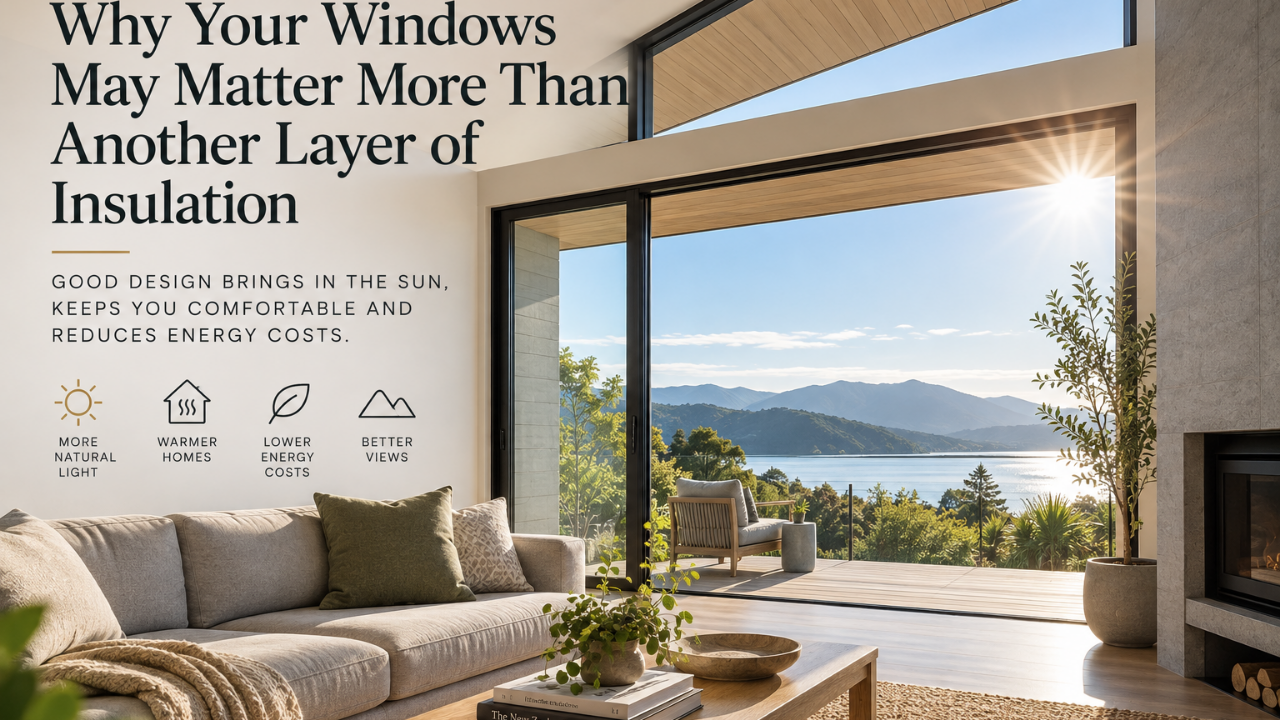
Why Your Windows May Matter More Than Another Layer of Insulation
When people start designing an energy-efficient home, insulation is usually one of the first things they focus on.
More insulation must mean a better-performing house, right?
Up to a point, yes.
But once a home has a reasonably good thermal envelope, adding another layer of insulation may provide less benefit than improving the windows.
Windows can be one of the weakest parts of a home's thermal envelope. At the same time, correctly designed windows can provide free winter heating, natural light, ventilation and a connection with the landscape.
That makes window design one of the most important—and often misunderstood—parts of designing a high-performance home.
At Stephan Meijer Architecture, we don't look at windows simply as openings in walls. Their size, orientation, location, frame and glazing all form part of the home's overall energy strategy.
Your Walls and Windows Perform Very Differently
A modern insulated wall can achieve a relatively high thermal resistance.
Even a good double-glazed window generally performs considerably worse thermally than the insulated wall surrounding it.
This means that increasing the amount of glazing in a house can have a major effect on overall heat loss.
You could spend additional money increasing wall insulation while simultaneously installing large areas of poorly positioned glazing.
The result may be a house that technically has excellent insulation but still requires significant heating.
The entire building envelope needs to work as one system.
More Glass Isn't Always Better
Large windows look fantastic in architectural photographs.
They provide views, daylight and a feeling of openness.
But there is a trade-off.
Large areas of glass can increase:
-
Winter heat loss
-
Summer overheating
-
Glare
-
Construction costs
-
Window covering costs
-
Heating and cooling requirements
The objective shouldn't therefore be to maximise glazing.
It should be to put the right amount of glass in the right places.
Orientation Changes Everything
A window facing north behaves very differently from one facing south, east or west.
In much of New Zealand, north-facing glazing can allow low winter sun deep into the house, providing free solar heating.
With properly designed eaves or external shading, the higher summer sun can then be prevented from entering the building.
This is the basis of passive solar design.
South-facing windows receive little direct winter solar gain and can therefore become primarily a source of heat loss.
East-facing windows provide useful morning sunlight.
West-facing windows can be problematic because low afternoon summer sun can cause significant overheating and is difficult to control with conventional horizontal eaves.
Window orientation can therefore be just as important as window specification.
The Cheapest Heating System Is the Winter Sun
One of the most powerful features available to an architect is completely free.
Sunlight.
If living areas and glazing are positioned correctly, winter sunlight can provide significant passive heating.
This can reduce the amount of energy required to keep the house comfortable.
The important point is that solar gain must be controlled.
Too much glazing without adequate summer shading can turn an energy-efficient home into an uncomfortable greenhouse.
Good passive solar design balances:
winter solar gain + summer shading + insulation + thermal mass + ventilation.
Window Frames Matter Too
When comparing windows, homeowners often concentrate on the glass.
But the frame can also have a substantial effect on performance.
Common options include:
-
Aluminium
-
Thermally broken aluminium
-
Timber
-
uPVC
-
Composite systems
Standard aluminium is highly conductive, meaning heat can travel relatively easily through the frame.
Thermally broken frames introduce a less conductive material between the internal and external aluminium sections, reducing this heat transfer.
In a high-performance home, considering the performance of the complete window—including glass, frame and installation—is more useful than looking at glazing alone.
Double Glazing Isn't All the Same
The words double glazed don't tell you everything about a window's performance.
Different glazing units can include:
-
Different cavity widths
-
Low-emissivity coatings
-
Argon gas
-
Warm-edge spacers
-
Different glass thicknesses
-
Different frame systems
These choices affect heat loss, solar gain and comfort.
Rather than simply asking whether a house has double glazing, a better question is:
How well does the complete window system perform?
Don't Forget Installation
You can buy an excellent high-performance window and still compromise its performance through poor detailing.
The junction between the window and the wall is particularly important.
Good detailing should consider:
-
Insulation continuity
-
Airtightness
-
Water management
-
Flashings
-
Thermal bridging
-
Window position within the wall
These details are difficult and expensive to correct after construction.
They are much easier to resolve properly during architectural design.
Comfort Is About More Than Air Temperature
Imagine sitting beside a large single-glazed window on a cold winter evening.
Even if the room temperature is 21°C, you may still feel cold.
This is partly because your body radiates heat towards the colder glass surface.
Higher-performing windows maintain warmer internal surface temperatures, making spaces beside windows significantly more comfortable.
This is one reason a well-designed high-performance home can feel warmer even when the thermostat is set at the same temperature as a conventional house.
When Does More Insulation Stop Being the Best Investment?
The first improvements to insulation generally provide significant benefits.
But insulation is subject to diminishing returns.
Moving from a poorly insulated building to a well-insulated one can produce a dramatic improvement.
Once insulation levels are already relatively high, adding still more may produce a comparatively small improvement.
At that point, money may sometimes be better invested in:
-
Better windows
-
Thermally improved frames
-
Airtightness
-
Reducing thermal bridges
-
Better orientation
-
External shading
-
Controlled ventilation
This is why high-performance design should never become a competition to achieve the highest possible R-value.
The objective is to achieve the best-performing house for the available budget.
Sometimes a Smaller Window Is the Better Window
One of the easiest ways to improve window performance doesn't involve buying a more expensive window.
Simply use less glass where it isn't providing a meaningful benefit.
Ask what each window actually does.
Does it provide:
-
A valuable view?
-
Useful daylight?
-
Winter solar gain?
-
Ventilation?
-
A connection to the garden?
If it does none of these things particularly well, perhaps it doesn't need to be as large.
Reducing unnecessary glazing can save money twice: once through lower construction costs and again through reduced heating and cooling requirements.
Spend Your Window Budget Where It Matters
Rather than specifying the same window solution throughout the entire house, think strategically.
You may want larger, higher-quality glazing where it contributes to living spaces, views and passive solar performance.
Elsewhere, smaller windows may be perfectly adequate.
This allows the available budget to be concentrated where it creates the greatest improvement in everyday living.
Cost-effective architecture isn't about making everything cheaper. It's about spending money where it makes the biggest difference.
Windows Should Be Designed at the Beginning
Window design should not be something added after the floor plan has been completed.
Orientation, room layout, views, shading and glazing should all be developed together.
Moving a window on a drawing costs almost nothing.
Trying to solve overheating, poor daylight or excessive heat loss after the house has been built can cost thousands.
This is another example of why so many of the most important decisions affecting a home's long-term performance happen during the design stage.
Designing for the Nelson and Tasman Climate
Nelson and Tasman enjoy excellent sunshine hours, creating significant opportunities for passive solar home design.
But abundant sunshine also means summer overheating needs careful consideration.
A successful home should therefore capture useful winter sun while controlling unwanted summer heat.
Depending on the site, this might involve:
-
North-facing living spaces
-
Carefully sized glazing
-
Roof overhangs
-
External shading
-
Reduced western glazing
-
Cross ventilation
-
Strategic thermal mass
On elevated and sloping sites around Nelson and Tasman, another challenge often arises: the best views don't necessarily face the best solar direction.
Good architecture is about resolving both.
A home should capture the view without sacrificing comfort and energy performance.
Don't Just Add More Insulation—Design a Better Building
Insulation is extremely important.
But it is only one component of a high-performance home.
Windows, orientation, airtightness, thermal bridging, ventilation and shading all interact with one another.
Simply increasing insulation without considering the rest of the building may not produce the result you expect.
The better question isn't:
“How much insulation can we put in?”
It's:
“Where will the next dollar make the biggest improvement to this home's performance?”
Sometimes the answer will be insulation.
But surprisingly often, it may be your windows.
Planning a High-Performance Home in Nelson or Tasman?
If you're planning a new home in Nelson, Richmond, Motueka, Mapua or the wider Tasman region, getting the orientation, glazing and building envelope right early can make a substantial difference to both comfort and long-term energy costs.
At Stephan Meijer Architecture, we design homes around their specific site, climate, views and budget rather than simply adding expensive products to a conventional design.
The goal is straightforward:
Use good design first, then use technology where it genuinely adds value.
Contact Stephan Meijer Architecture to discuss how thoughtful window design, passive solar principles and a balanced building envelope can create a warmer, healthier and more energy-efficient home.
