
Enduring Architecture | Designing Timeless Homes in New Zealand
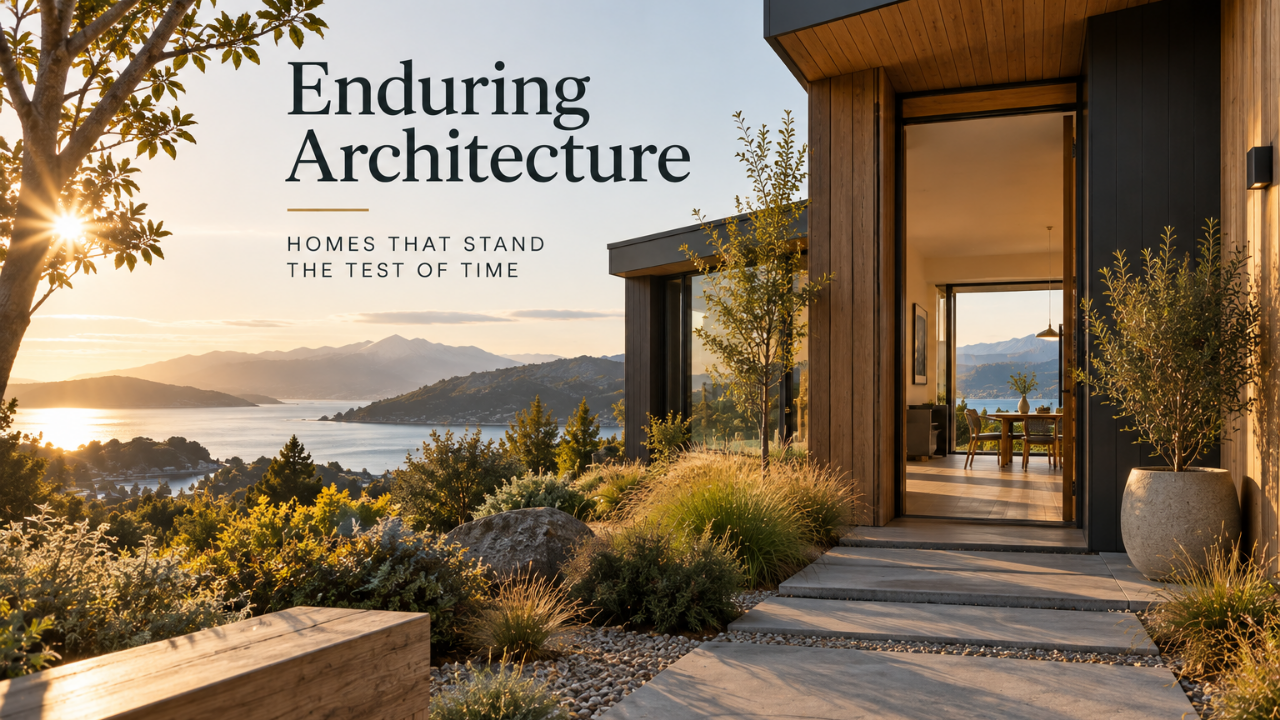
Enduring Architecture: Designing Homes That Stand the Test of Time
Architecture is often judged when a building is new.
The photographs are taken, the landscaping is fresh, the materials are pristine and everything reflects the design trends of the moment.
But perhaps the more important question is:
What will the house be like in 20, 30 or even 50 years?
Will it still function well?
Will the materials have aged gracefully?
Will future owners want to renovate it—or demolish it?
Will it still feel appropriate to its landscape?
At Stephan Meijer Architecture, we believe good architecture should be designed for the long term. An enduring home is not simply one that remains standing. It is a building that continues to provide comfort, beauty and usefulness as lifestyles, technologies and families change.
That is what we mean by enduring architecture.
What Is Enduring Architecture?
Enduring architecture combines several qualities:
-
Timeless design
-
Durable materials
-
Practical construction
-
Energy efficiency
-
Adaptability
-
Good proportions
-
Connection to place
-
Ease of maintenance
It avoids unnecessary complexity and short-lived fashions in favour of architecture that can mature gracefully.
A truly sustainable building isn't necessarily the one with the most environmental technology.
Often, it is simply the building people still value enough to keep 100 years later.
Timeless Doesn't Mean Traditional
When people hear the word timeless, they sometimes imagine traditional architecture.
But contemporary architecture can be equally enduring.
Timelessness is less about architectural style and more about fundamental design principles.
Good proportions rarely become outdated.
Natural light doesn't go out of fashion.
A beautiful view will still matter in 30 years.
A warm house will still be desirable.
A sheltered outdoor area will still be useful.
A logical floor plan will continue to make everyday life easier.
The most enduring architecture often concentrates on these fundamentals rather than trying too hard to look fashionable.
Be Careful With Trends
Every generation of architecture has its trends.
Some become established design principles. Others disappear surprisingly quickly.
Highly fashionable colours, unusual building forms, complicated rooflines and novelty materials can make a house feel contemporary today but dated relatively quickly.
That doesn't mean architecture should be conservative.
There is plenty of room for character, individuality and experimentation.
But the strongest ideas should come from the site, climate, materials and needs of the people living there, rather than simply from whatever happens to be fashionable at the time.
Start With the Site
Enduring architecture begins with understanding the land.
Before designing the building, consider:
-
Sun
-
Wind
-
Topography
-
Views
-
Vegetation
-
Access
-
Privacy
-
Neighbouring development
-
Local climate
A house that responds naturally to these conditions tends to feel as though it belongs.
This is particularly important in Nelson and Tasman, where building sites can vary enormously—from urban sections in Nelson and Richmond to coastal sites, rural lifestyle blocks and steep hillsides overlooking Tasman Bay.
A design copied from another site may technically fit.
But a home designed specifically for its location can become part of the landscape.
Orientation Never Goes Out of Fashion
Some architectural decisions provide benefits for the entire life of the building.
Orientation is one of them.
Positioning living areas to benefit from winter sun can make a house warmer, brighter and more comfortable.
Carefully designed shading can then prevent excessive summer heat.
Good orientation can also improve:
-
Natural lighting
-
Views
-
Privacy
-
Outdoor living
-
Natural ventilation
Heating systems will eventually need replacing.
Technology will change.
But the sun will continue rising and setting in the same place.
Getting orientation right at the beginning is one of the most enduring design decisions you can make.
Keep the Building Form Simple
Simple architecture can be incredibly powerful.
A well-proportioned building doesn't need dozens of corners, roof junctions or complicated forms to be interesting.
In fact, simplicity often improves durability.
Every additional junction can introduce:
-
Flashings
-
Waterproofing details
-
Structural connections
-
Maintenance requirements
-
Potential failure points
Simple building forms are generally easier to construct, easier to weatherproof and easier to maintain.
They can also be more cost-effective.
This doesn't mean creating boring buildings.
It means achieving architectural interest through proportion, materials, light, landscape and carefully considered details rather than unnecessary complexity.
Choose Materials That Age Gracefully
There is an important difference between a material getting older and a material ageing well.
Some materials develop character.
Timber can weather.
Stone can soften visually.
Metals can develop patina.
Well-detailed concrete can become richer with age.
Other materials can deteriorate quickly or require frequent replacement to maintain their original appearance.
When selecting materials, don't just ask:
“How does this look today?”
Also ask:
“How will this look after 20 years of Nelson sun, rain and wind?”
That question can completely change a material decision.
Durability Starts With Detailing
Expensive materials don't automatically create durable buildings.
Good detailing does.
Water needs somewhere to go.
Cladding needs to drain and dry.
Roof junctions need to be resolved properly.
Windows need appropriate flashing.
Timber needs protection where necessary.
Maintenance needs to be physically possible.
Many building failures occur not because the basic material was inappropriate but because water, movement or exposure wasn't properly considered.
An enduring building should be designed around how materials actually behave over time.
Design for Maintenance
Every house requires maintenance.
The question is how much.
Some architectural decisions can create decades of unnecessary work.
Consider:
-
Can gutters be reached and cleaned?
-
Can exterior walls be safely maintained?
-
Will painted finishes require frequent recoating?
-
Are roof junctions unnecessarily complicated?
-
Can windows and exterior components eventually be replaced?
-
Are landscaping and drainage systems accessible?
A house that looks impressive but requires expensive specialist access every few years may not be particularly successful over its lifetime.
Low-maintenance architecture begins on the drawing board.
Design for Change
Families rarely remain exactly the same.
Children arrive.
Children leave.
People work from home.
Parents move in.
Mobility changes.
A spare bedroom becomes an office.
A garage becomes a workshop.
Technology changes how we use our homes.
Enduring architecture anticipates some of this uncertainty.
That doesn't mean trying to predict exactly how people will live in 30 years.
Instead, create spaces that are capable of changing.
A room with sensible proportions and good natural light can become a bedroom, office, studio or second living space.
A ground-floor bathroom may become increasingly valuable later in life.
A slightly wider doorway may make future accessibility much easier.
Flexibility allows a building to remain useful for longer.
Avoid Overspecialised Spaces
Highly specific rooms can sound appealing during the design process.
But they can also become redundant.
Rather than creating a room that can only perform one function, consider whether it could serve several purposes over its lifetime.
For example:
Guest bedroom + office + future accessible bedroom
may be more valuable than three separate specialised spaces.
This approach can reduce floor area while increasing flexibility.
It is another example of how good design can allow us to build less while achieving more.
Build the Right Size
An enduring house doesn't need to be enormous.
In fact, excessively large homes can eventually become expensive to heat, maintain and renovate.
A carefully designed smaller house can provide better:
-
Room proportions
-
Circulation
-
Natural light
-
Storage
-
Indoor-outdoor connections
-
Energy efficiency
Instead of asking:
“How large can we make the house?”
A better question may be:
“How much house do we actually need?”
Money saved on unnecessary floor area can then be invested in better windows, insulation, materials and architectural detailing.
Energy Efficiency Is Part of Longevity
A house that becomes increasingly expensive to heat and cool may eventually require major upgrading.
That makes energy performance part of enduring design.
A long-lasting home should consider:
-
Passive solar orientation
-
Good insulation
-
High-performance windows
-
Airtightness
-
Controlled ventilation
-
Summer shading
-
Natural ventilation
-
Efficient heating
-
Renewable energy where appropriate
Importantly, many of the best energy-efficiency measures are architectural rather than technological.
Good orientation, compact form and appropriate glazing don't become obsolete when a new technology arrives.
Design the Structure for the Long Term
Structural decisions can also affect adaptability.
Removing or relocating major structural elements later can be expensive.
Where practical, clear structural layouts can make future alterations easier.
This is especially important when designing large open-plan spaces or homes that may eventually be subdivided into different living zones.
Thinking ahead doesn't necessarily add significant cost.
Often it simply requires asking the right questions during design.
Good Architecture Should Become More Valuable With Time
There is something special about a building that improves as it ages.
Trees mature around it.
Timber develops character.
Gardens soften the architecture.
The house becomes increasingly connected to its surroundings.
This is very different from architecture designed primarily for immediate visual impact.
The aim shouldn't necessarily be to create a house that looks brand new forever.
It should be to create one that still looks good when it no longer is.
Sustainability Means Keeping Buildings
We often discuss sustainable architecture in terms of insulation, solar panels and energy consumption.
These are important.
But there is another fundamental aspect of sustainability:
Don't demolish buildings unnecessarily.
Constructing a house requires substantial quantities of materials, labour, transport and energy.
If a building becomes undesirable or unusable after only a few decades, much of that investment is lost.
A building that remains useful and valued for generations spreads its environmental impact across a much longer lifespan.
Perhaps one of the most sustainable things an architect can therefore do is design a building that future generations won't want to tear down.
Enduring Architecture Can Also Be Cost-Effective
Designing for longevity doesn't necessarily mean specifying the most expensive products.
Often it means making better decisions.
Spend money where it matters:
-
Good orientation
-
A logical floor plan
-
Durable construction
-
Appropriate windows
-
Good insulation
-
Simple roof forms
-
Quality weatherproofing
-
Carefully considered materials
And avoid spending unnecessarily on:
-
Excessive floor area
-
Complicated building forms
-
Fashion-driven features
-
Unnecessary structural complexity
-
Materials chosen primarily for appearance
The objective is not to build the cheapest house possible.
It is to achieve the greatest long-term value from the money available.
Architecture Should Outlast Fashion
A home may take several years to design and build.
But hopefully, it will remain standing for many generations.
That makes designing primarily around today's trends seem surprisingly short-sighted.
Enduring architecture takes a longer view.
It asks:
Will this still work?
Will it still be comfortable?
Can it adapt?
Can it be maintained?
Will the materials age well?
Will people still enjoy living here?
And perhaps most importantly:
Will someone still think this building is worth caring for in 50 or 100 years?
If the answer is yes, the architecture has achieved something far more valuable than simply looking fashionable when it was completed.
Designing Enduring Homes in Nelson and Tasman
At Stephan Meijer Architecture, we design homes throughout Nelson, Richmond, Motueka, Mapua and the wider Tasman region with a focus on site-responsive, practical and enduring architecture.
Whether a project is on a steep hillside, an urban section, a rural lifestyle block or a coastal site, our aim is to create homes that respond to their environment and continue working beautifully for decades.
We believe good architecture should be:
Simple enough to last.
Flexible enough to change.
Efficient enough to remain affordable.
And beautiful enough to be worth keeping.
If you're planning a new home or substantial renovation in Nelson or Tasman, contact Stephan Meijer Architecture to discuss how thoughtful design can create a home that stands the test of time.
